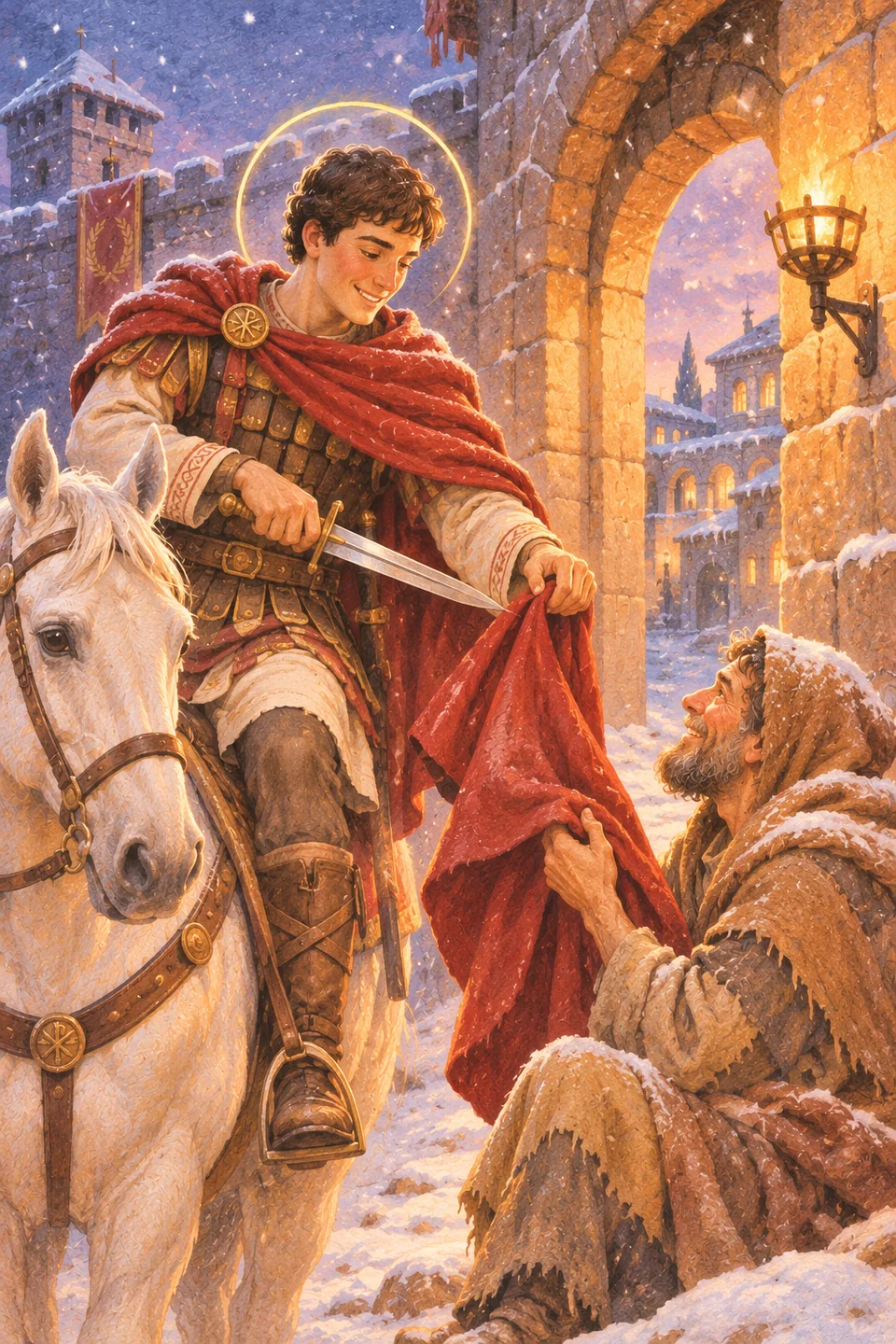
Half a cloak
It was a bitterly cold winter in the town of Amiens, in what is now France. At the town gate sat a poor man with hardly any clothes, shivering. People walked straight past him.
Martin, a young soldier, had already given away almost everything he owned. All he had left were his weapons and his soldier’s cloak. So he drew his sword, cut the cloak in two and gave half to the beggar. Some people laughed at how silly he looked in half a cloak.
Source: Sulpicius Severus, Life of St Martin, chapter 3
The dream
That night Martin dreamed that he saw Jesus wearing the half of the cloak he had given away. Jesus turned to the angels around him and said: “Martin, who is still but a catechumen, clothed me with this robe.”
A catechumen is someone getting ready to be baptised. Soon afterwards, Martin was baptised.
Source: Sulpicius Severus, Life of St Martin, chapter 3
A soldier of Christ
Martin hadn’t chosen to be a soldier. His father was an army officer, and Martin was made to join the army at 15. Once he was baptised, he wanted to leave and serve God instead.
When a battle was coming, Martin told Julian, who commanded the army in Gaul for the emperor, that he would not fight any more. Julian said Martin was just afraid of the battle. So Martin offered to stand in front of the army the next day with no weapons at all, protected only by the sign of the cross. But the next morning the enemy sent messengers asking for peace, and there was no battle.
Source: Sulpicius Severus, Life of St Martin, chapters 2 and 4
A scruffy bishop
After leaving the army, Martin started one of the first monasteries in Gaul (France), at Ligugé, and people came from far and wide to see him. When the people of Tours wanted him as their bishop, they had to trick him into leaving his monastery: a man came to ask him to visit his sick wife.
Some of the other bishops were not impressed. They said Martin was not fit to be a bishop, with his shabby clothes and messy hair. The people chose him anyway.
Source: Sulpicius Severus, Life of St Martin, chapters 7 and 9; Catholic Encyclopedia (1910), “Ligugé”
Hiding with the geese
Legend A very old story that may not have happened exactly like this.
A much later story says that Martin didn’t want to be a bishop at all, and hid in a barn full of geese. The geese honked so loudly that they gave him away!
That’s one reason why, in some countries, people eat roast goose on St Martin’s Day, 11 November.
Source: Liturgical Arts Journal, “Customs of Martinmas” (2018)
When it was hard
Martin wanted to serve God, but he was made to be a soldier for years. When he tried to leave, he was accused of cowardice.
Later, important people looked down on him for his shabby clothes and messy hair, and said he wasn’t good enough to be a bishop. Martin didn’t change. He kept living simply and serving the poor.
Source: Sulpicius Severus, Life of St Martin, chapters 4, 9 and 10
O Lord, if I am still necessary to your people, I do not shrink from toil: your will be done.
Try this
- Go through your cupboards as a family and choose some warm clothes to give to people who need them.
- On 11 November, make paper lanterns and go for a lantern walk, as children do on St Martin’s Day in Germany, the Netherlands and other countries.
A prayer
St Martin, you shared what you had with a stranger in the cold. Help us to notice people in need, and to share gladly. Pray for us.
For grown-ups: more about St Martin of Tours
Martin (about 316 to 397) was born in Savaria in Pannonia (today’s Szombathely in Hungary) and grew up in Pavia in Italy. As the son of a veteran he was enrolled in the Roman cavalry. After leaving the army he became a disciple of St Hilary of Poitiers, founded the monastery of Ligugé, and in 371 became Bishop of Tours, where he founded the monastery of Marmoutier. He died at Candes in 397. His birth year is uncertain: about 316 is traditional (he is said to have died aged about 81), but Sulpicius’ account of his leaving the army under Julian, in 356, fits a birth around 336 better.
Almost everything we know about him comes from his friend and admirer Sulpicius Severus, whose Life of St Martin was written while Martin was still alive. Martin was one of the first saints to be honoured who was not a martyr, and his feast, Martinmas, was one of the great festivals of medieval Europe. The goose story is a later legend. The word “chapel” comes from cappella, “little cloak”: the shrine that kept his cloak.