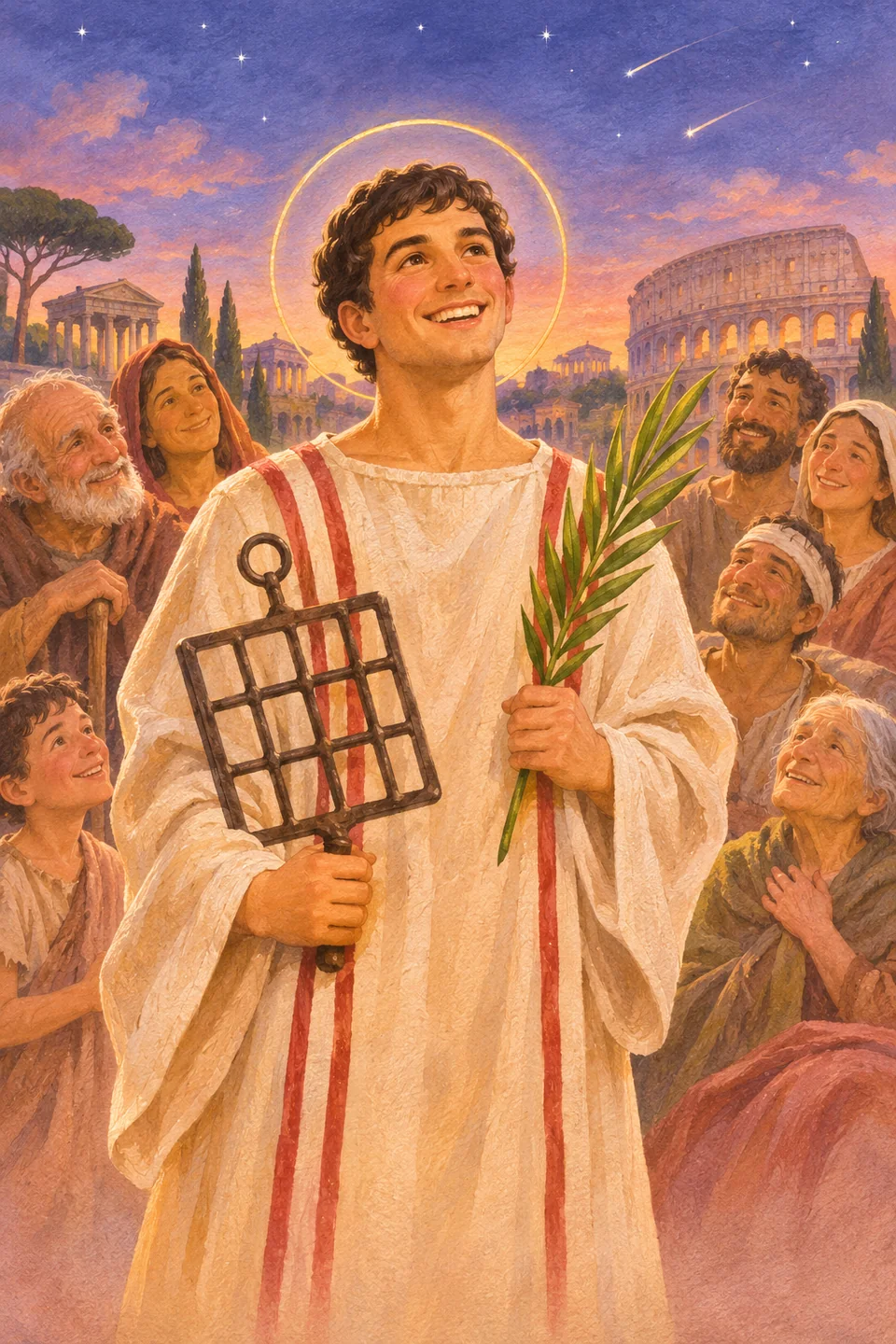
Don’t go without me
Legend A very old story that may not have happened exactly like this.
Lawrence’s bishop, and his close friend, was Pope Sixtus II. In August 258, Sixtus was arrested and put to death.
St Ambrose tells how Lawrence saw his bishop being led away and began to weep: “Where, father, are you going without your son?” Sixtus told him that a greater struggle was waiting for him, and that he would follow in three days.
Source: St Ambrose, On the Duties of the Clergy, Book 1, chapter 41, sections 214 and 215
The treasure of the Church
The Roman officials thought the Church must be hiding gold and silver, and they ordered Lawrence to hand it over.
St Ambrose tells how Lawrence promised to show them. The next day he gathered together the poor people the Church looked after, and pointed to them. “These are the treasures of the Church,” he said.
Source: St Ambrose, On the Duties of the Clergy, Book 2, chapter 28, sections 140 and 141
Turn me over
Legend A very old story that may not have happened exactly like this.
The old story says Lawrence was put to death on a gridiron, a metal grill over a fire. He was so full of God’s love that he hardly seemed to notice. He even joked that one side was done, and they should turn him over.
That is why Lawrence is the patron saint of cooks. Historians think he may really have been killed in a different way, but Christians have told this story for over 1,600 years because it shows that love can be stronger than fear.
Source: St Ambrose, On the Duties of the Clergy, Book 1, chapter 41, section 216; Catholic Encyclopedia (1910), “St. Lawrence”
Tears in the sky
Every year in August, around Lawrence’s feast day, the Perseid meteor shower sends shooting stars streaking across the night sky. In Italy people call them “the tears of St Lawrence”, and make a wish when they see one.
Source: ANSA, “Perseid meteor shower to peak on Tuesday and Wednesday” (2025)
When it was hard
Lawrence lost his friend and bishop, and knew the same could happen to him. The emperor had ordered that Church leaders be put to death, and many poor families depended on him.
Being brave didn’t make the danger go away. It meant Lawrence kept doing his job, caring for people and trusting God, even when it was frightening.
These are the treasures of the Church.
Try this
- Look around for the “treasures of the Church” near you: someone lonely, someone sick, someone who needs a meal. As a family, choose one thing to do for one of them this week.
- On a clear night between 10 and 13 August, go outside, look up and count the tears of St Lawrence.
A prayer
St Lawrence, you saw treasure in people others ignored. Help us to see it too, and to stay brave and cheerful when doing good is hard. Pray for us.
For grown-ups: more about St Lawrence of Rome
Lawrence was one of the seven deacons of Rome under Pope Sixtus II during the persecution of Valerian. Valerian’s edict of 258 ordered bishops, priests and deacons to be executed at once, and Sixtus was executed on 6 August. Lawrence died four days later, on 10 August.
The earliest accounts of his death come over a century later, from St Ambrose and the poet Prudentius, and they include the gridiron. Because clergy condemned under the edict were normally put to the sword (St Cyprian was beheaded the same year), many historians doubt the gridiron; the Catholic Encyclopedia says the story “gives rise to grave doubts”. What is certain is that he was buried on the Via Tiburtina, that Constantine built the first small chapel over his grave (later rebuilding produced today’s Basilica of San Lorenzo fuori le Mura), and that he is named in the Roman Canon, the first Eucharistic Prayer.