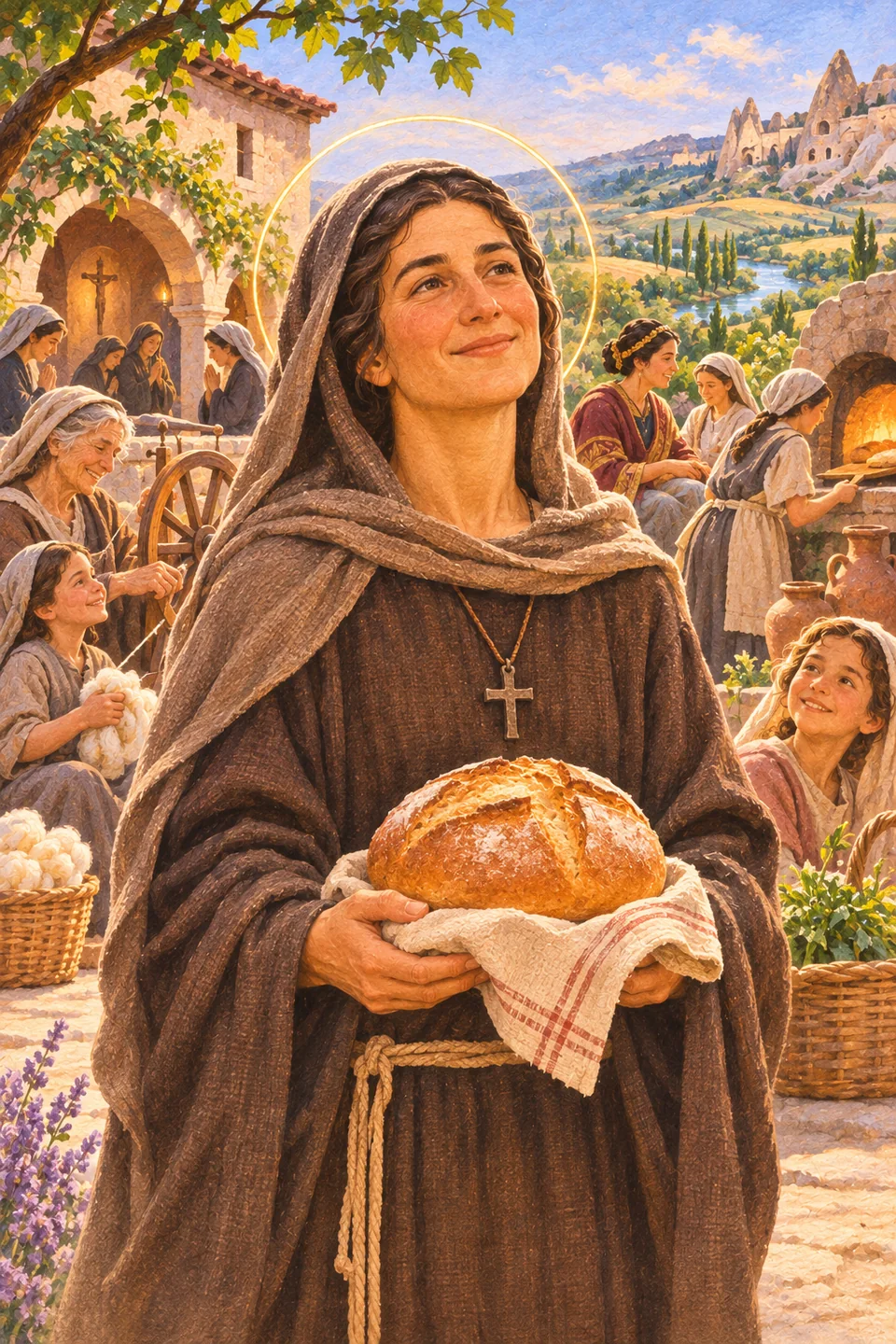
A secret name
Before Macrina was born, her mother had a dream. Someone shining appeared and three times called the baby by the name Thecla, after a brave Christian woman from long before. So Macrina grew up with a secret name.
As a little girl she came to know every part of the Psalms, and said them all through the day: when she got up, while she worked and rested, at meals and at bedtime. She also became very skilled at working with wool.
Source: St Gregory of Nyssa, Life of St Macrina (tr. W. K. Lowther Clarke, 1916; chapter numbers as in Maraval’s edition), chapters 2 to 4
A big-headed brother
When her brother Basil came home from university in Athens, he was very pleased with himself. Gregory says he was “puffed up beyond measure” by his talent for speaking, and looked down on the important people of the district.
Macrina took him in hand. She drew him towards a simpler life of prayer and service, and he gave up chasing fame. Basil became one of the greatest saints and teachers of the Church, with a big sister to thank.
Source: St Gregory of Nyssa, Life of St Macrina (tr. W. K. Lowther Clarke, 1916; chapter numbers as in Maraval’s edition), chapter 6
Bread with her own hands
In those days rich families had servants, many of them slaves, to do all the hard work. Macrina persuaded her mother to live with their maids as sisters and equals, sharing the same food, the same kind of bed and everything else.
Macrina baked bread for her mother with her own hands, a job a wealthy daughter would never normally do. Later, when famine struck, Macrina rescued girls who had been left by the roadside, and nursed and raised them herself.
Source: St Gregory of Nyssa, Life of St Macrina (tr. W. K. Lowther Clarke, 1916; chapter numbers as in Maraval’s edition), chapters 5, 7, 11 and 26 (the Greek of chapter 5 says she made bread; this translation has “meals”)
The little girl’s eye
After Macrina died, a soldier told Gregory about a visit his family had made to her community. Their little daughter had a sore, clouded eye, left over from an illness. Macrina kissed the little girl, put her lips to the sore eye, and promised a medicine.
On the way home they realised they had forgotten to take the medicine. Then the mother looked at her daughter. The eye was healed.
Source: St Gregory of Nyssa, Life of St Macrina (tr. W. K. Lowther Clarke, 1916; chapter numbers as in Maraval’s edition), chapters 36 to 38
A teacher to the end
When Gregory came to visit for the last time, Macrina was very ill, lying on a board covered with sackcloth, with another board for a pillow. Even so, she spent their last conversations cheering him up and talking about the soul and the resurrection. Later Gregory wrote a book, On the Soul and the Resurrection, as a conversation between them.
She owned almost nothing: a cloak, a veil and worn-out shoes. Around her neck she wore a small iron cross and a ring holding a tiny piece of the Cross of Jesus.
Source: St Gregory of Nyssa, Life of St Macrina (tr. W. K. Lowther Clarke, 1916; chapter numbers as in Maraval’s edition), chapters 16 to 18, 29 and 30; St Gregory of Nyssa, On the Soul and the Resurrection
When it was hard
When Macrina was twelve, her parents arranged for her to marry a young man when she was older. He died suddenly before the wedding. Macrina decided not to marry anyone else, and to give her life to God and to caring for her mother.
There was more sadness to come. Her father died when her youngest brother, Peter, was a newborn. Later her brother Naucratius died suddenly while out fetching food for the old people he cared for, and in time her mother and her brother Basil died too. Each time, Macrina helped her family to grieve with faith, even when her own heart was breaking.
Thou, O Lord, hast freed us from the fear of death. Thou hast made the end of this life the beginning to us of true life.
Try this
- Macrina helped her brother when he was getting big-headed. Who in your family helps you to be your best self? Tell them thank you.
- Bake bread, or anything, together as a family, and give some away.
A prayer
St Macrina, you were a big sister, a teacher and a friend to the poor. Help us to tell each other the truth with love, and to serve one another gladly. Pray for us.
For grown-ups: more about St Macrina the Younger
Macrina (about 327 to 379) is known almost entirely through her brother Gregory of Nyssa: his Life of Macrina, written a few years after her death (about 381 or 382), and his dialogue On the Soul and the Resurrection, in which she is the teacher and he is the student.
Her family is remarkable: her grandmother Macrina the Elder, her parents Basil and Emmelia, and her brothers Basil the Great, Gregory of Nyssa and Peter of Sebaste are all venerated as saints. Her community at Annisa, on the family estate by the River Iris in Pontus, was one of the early communities of consecrated women in the East. Basil himself spent time there as a monk in the 350s, though he never mentions her in his writings. Pope Benedict XVI said that Macrina helped to guide Gregory’s Christian education and “was always a guide and example for him”.