Little sips from the cellar
When Monica was a girl, her parents sent her down to the cellar to fetch wine. Before pouring it out of the barrel, she began taking tiny sips. Each day she took a little more, until she was drinking her little cup nearly full.
One day she argued with the maid who went with her, and the maid called her a drunkard. The insult stung, because it was true. Monica stopped, right then, and never did it again.
Source: St Augustine, Confessions, Book 9, chapter 8
Calm in a stormy house
Monica’s husband Patricius was generous but quick to lose his temper, and he wasn’t a Christian. Monica learned not to argue with him while he was angry. She waited until he had calmed down, and then explained herself.
Her mother-in-law was against her at first, because servants told tales about her. Monica won her over with patience and kindness. Before he died, Patricius was baptised.
Source: St Augustine, Confessions, Book 9, chapter 9
The son of these tears
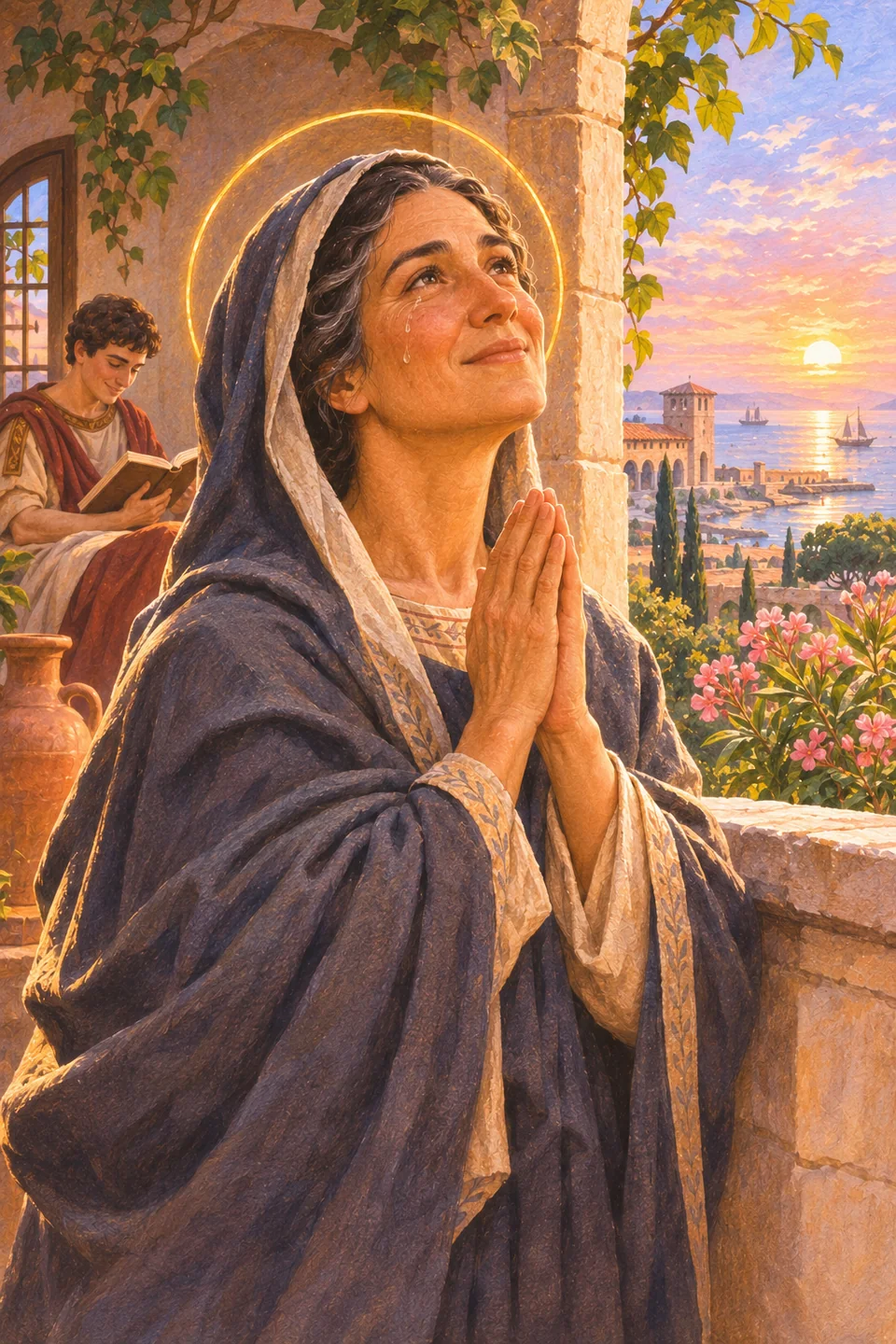
Augustine grew up clever and restless. He joined a religion called Manichaeism and made fun of his mother’s faith. Monica cried and prayed for him for years.
She begged a bishop to talk to Augustine. The bishop said Augustine wasn’t ready to listen yet. But Monica kept pleading, with tears running down her face, until the bishop said: “Go your way, and God bless you, for it is not possible that the son of these tears should perish.”
Source: St Augustine, Confessions, Book 3 (tr. J. G. Pilkington), chapters 11 and 12
The night he sailed away
When Augustine decided to move to Rome, Monica wanted to come too. He didn’t want her to. So he told her he was just keeping a friend company until the friend’s ship sailed, and he sailed away himself in the night, while she prayed in a chapel by the sea. In the morning, the ship was gone.
Monica didn’t give up. Later she crossed the sea herself to join him in Milan. When the voyage became dangerous, it was Monica who comforted the sailors, promising them they would arrive safely, because God had shown her so in a vision.
Source: St Augustine, Confessions, Book 5, chapter 8; St Augustine, Confessions, Book 6, chapter 1
A window at Ostia
In Milan, Augustine finally became a Christian, and he was baptised at Easter in 387. Afterwards, as they waited to sail home to Africa, mother and son leaned out of a window over a garden in the port of Ostia, talking about heaven so joyfully that for a moment they felt they had touched it.
Monica said there was nothing left that she wanted in this life. About five days later she fell ill with a fever, and nine days after that she died.
Source: St Augustine, Confessions, Book 9, chapters 10 and 11
When it was hard
Monica’s struggle was waiting. For years she prayed for her husband and her son and saw nothing change. She cried so much that Augustine wrote about her tears watering the ground. As a girl she even had to fight a bad habit of her own.
Monica shows that saints aren’t people who never struggle. They are people who keep turning back to God, again and again.
Source: St Augustine, Confessions, Book 3 (tr. J. G. Pilkington); St Augustine, Confessions, Book 9
Lay this body anywhere, let not the care for it trouble you at all. This only I ask, that you will remember me at the Lord’s altar, wherever you be.
Try this
- Who are you praying for? Write their name on a slip of paper and keep it where you’ll see it. Pray for them every day this week, and don’t give up if nothing seems to change.
- Next time someone in your family is grumpy, try Monica’s way: stay calm and wait until later to talk it over.
A prayer
St Monica, you never gave up on the people you loved. Teach us to pray with patience and to keep loving, even while we are still waiting. Pray for us.
For grown-ups: more about St Monica
Nearly everything we know about Monica comes from her son’s Confessions, especially Book 9, written about ten years after her death. Augustine is frank about her: her girlhood drinking, her tears, her hard marriage, even her too-possessive love for him.
She died at Ostia in 387, aged 55, in her fifty-sixth year. Her relics were moved to Rome in 1430 and rest in the Basilica of Sant’Agostino. Her feast, 27 August, falls the day before her son’s. She is often invoked by mothers, by wives in difficult marriages, and for people struggling with addiction.