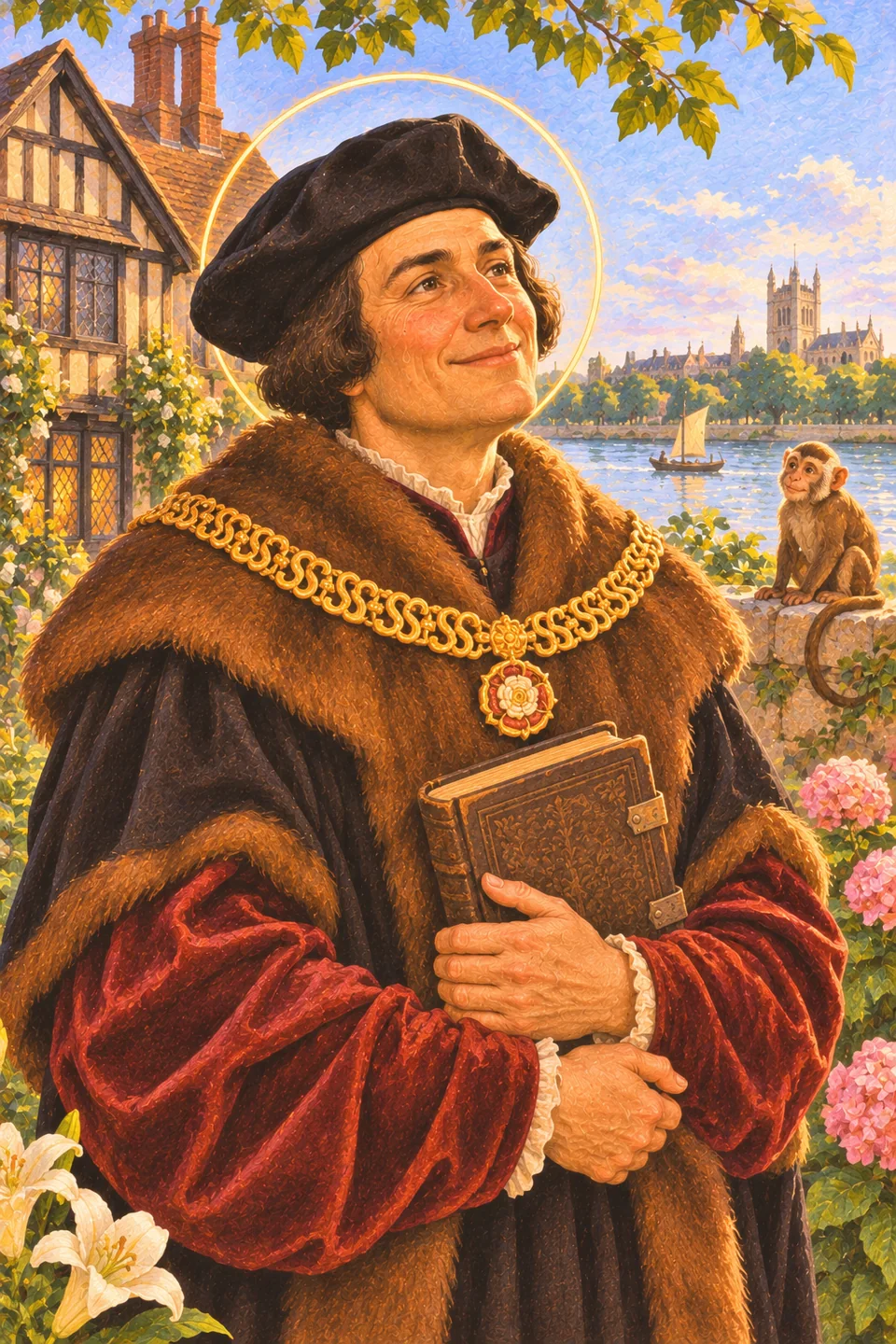
The boy who joined the play
As a boy, Thomas worked as a page in the house of Cardinal Morton, the Archbishop of Canterbury. At Christmas, when actors performed plays for the guests, young Thomas would suddenly step in among them and make up a part on the spot, so cleverly that everyone loved it.
The Cardinal used to say that this boy waiting at his table would grow up to be “a marvellous man”.
Source: William Roper, The Life of Sir Thomas More (c. 1556)
A house full of animals
Thomas’s home in London was full of life. His friend Erasmus wrote that Thomas loved watching animals and kept all sorts, including a monkey, a fox, a ferret, a weasel and lots of birds.
Thomas also made sure his daughters had the same education as boys, learning Latin, Greek and astronomy, which was very unusual then. His daughter Margaret became one of the most learned women in England.
Source: Erasmus, letter to Ulrich von Hutten (1519); St Thomas More, letter to his children (1521); St Thomas More, letter to William Gonell (1518)
Locked in the Tower
In 1534 King Henry VIII ordered important people to swear an oath that rejected the Pope’s authority over the Church in England. Thomas would not swear it, and he would not say why: he hoped his silence would keep him safe without telling a lie.
He was locked in the Tower of London for almost fifteen months. His family begged him to give in. When his wife Alice visited and told him to swear and come home, he teased her gently: “Is not this house as nigh heaven as mine own?”
Source: William Roper, The Life of Sir Thomas More (c. 1556)
The King’s good servant
In July 1535 Thomas was put on trial, and a man named Richard Rich lied about him so that he would be found guilty. He was sentenced to death.
Even then he joked. The steps up to the scaffold were wobbly, so he said to the officer: “I pray you, Master Lieutenant, see me safe up, and for my coming down let me shift for myself.” He told the crowd that he died the King’s good servant, and God’s first.
Source: William Roper, The Life of Sir Thomas More (c. 1556); The Paris Newsletter’s account of More’s execution (1535)
When it was hard
Thomas More was scared. In the Tower he admitted that he knew how weak and faint-hearted he was by nature. He said that if fear ever began to drown him, he would do what St Peter did when he began to sink in the waves: call out to Jesus for help. He worried about his family, who had lost everything because of him.
He didn’t feel brave. He asked God to give him strength, and trusted that God would. Being brave doesn’t mean you aren’t afraid. It means you do the right thing anyway.
Source: Margaret Roper, letter to Alice Alington (1534), in Roper’s Life, 1905 edition
The King’s good servant, and God’s first.
Try this
- Thomas More loved a good laugh. At dinner tonight, everyone shares the funniest thing that happened to them this week.
- Think of a time when it would be easier to tell a lie. Ask St Thomas More to help you tell the truth, even when it’s hard.
A prayer
St Thomas More, you were cheerful, honest and loyal to God above everything. Help us to tell the truth even when it costs us, and to keep our sense of humour. Pray for us.
For grown-ups: more about St Thomas More
More (1478 to 1535) trained as a lawyer, and for about four years lived alongside the Carthusians of the London Charterhouse, testing a call to religious life. He married Jane Colt, who died young, and then Alice Middleton. He wrote Utopia (1516), served in Parliament and as its Speaker, and became Lord Chancellor in 1529, resigning in 1532 as Henry VIII broke with Rome.
Refusing the Oath of Succession, whose preamble repudiated papal authority, he was imprisoned in April 1534, convicted of treason on evidence widely believed to be perjured, and beheaded on Tower Hill on 6 July 1535, two weeks after St John Fisher. Both were canonised in 1935, and they share a feast day. In 2000 St John Paul II named More the patron of statesmen and politicians, while noting frankly that in his actions against heretics he “reflected the limits of the culture of his time”. The much-shared “Prayer for Good Humour” is often attributed to him, but it isn’t his: it was written centuries later.
Where these stories come from
- William Roper, The Life of Sir Thomas More (c. 1556)
- Erasmus, letter to Ulrich von Hutten (1519)
- St Thomas More, letter to his children (1521)
- St Thomas More, letter to William Gonell (1518)
- The Paris Newsletter’s account of More’s execution (1535)
- Margaret Roper, letter to Alice Alington (1534), in Roper’s Life, 1905 edition
- Moreana 36 (1972), on the “Prayer for Good Humour”
- St John Paul II, Apostolic Letter proclaiming St Thomas More patron of statesmen and politicians, 2000