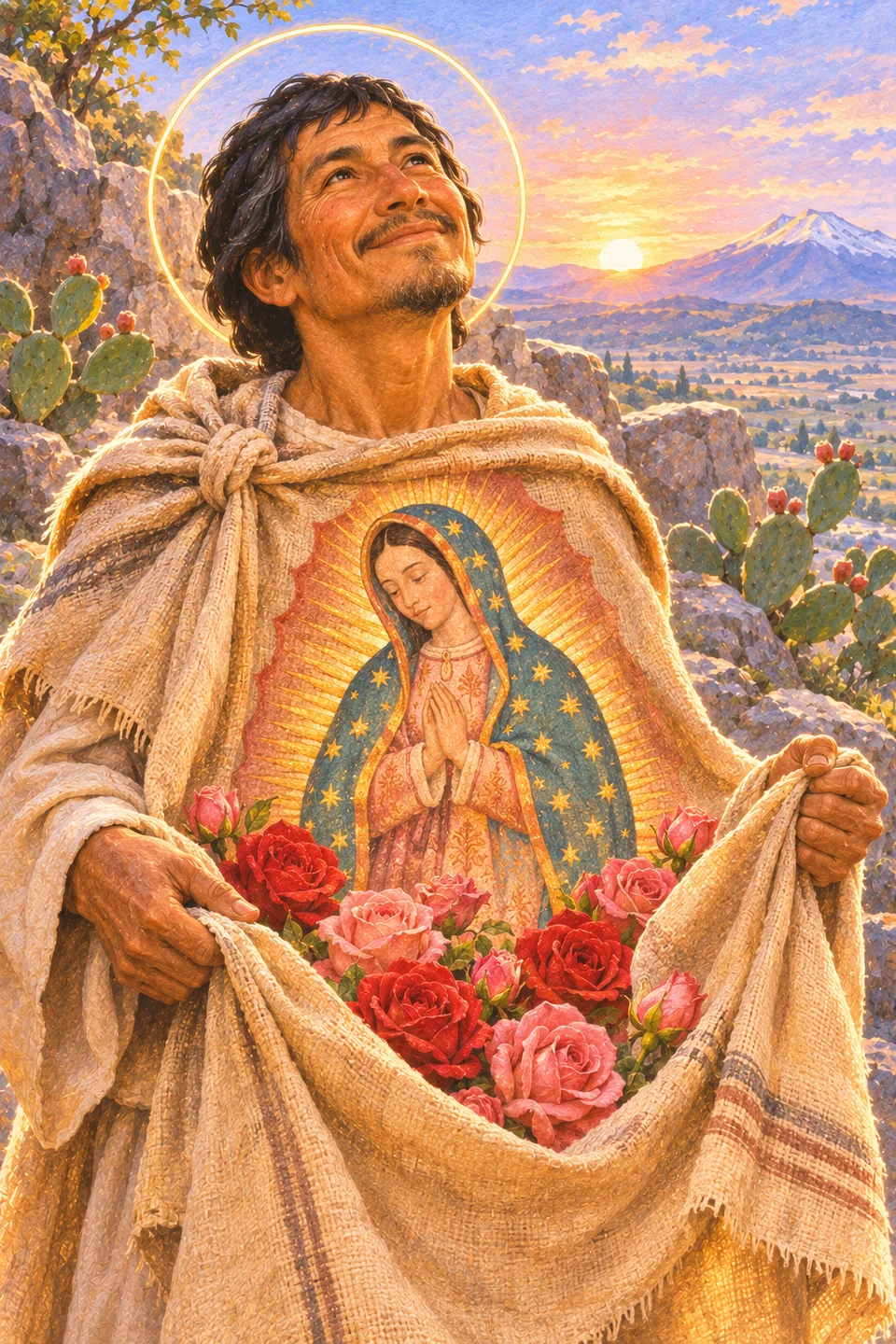
The lady on the hill
Early one December morning in 1531, Juan Diego was walking to church when he heard beautiful birdsong coming from the hill of Tepeyac. Then a voice called him tenderly by name: “Juanito, Juan Dieguito”, like saying “dear little Juan”.
At the top of the hill stood a lady whose clothes shone like the sun. She told him she was the Virgin Mary, and asked him to go to the bishop and ask for a little church to be built there, where she could show her love to everyone who came.
Source: Nican Mopohua, the account of the apparitions (English translation)
Send someone more important
The bishop, Juan de Zumárraga, listened politely but didn’t believe him. Juan Diego went back to the lady feeling like a failure. He begged her to send someone important instead. He said he was a nobody, a little man, like the tail end of something, who needed to be led himself.
Mary told him she had many servants she could send. But she had chosen him.
Source: Nican Mopohua, the account of the apparitions (English translation)
Taking the long way round
Then Juan Diego’s uncle, Juan Bernardino, fell gravely ill. Juan Diego rushed off to fetch a priest, and took a different path around the hill, so the lady wouldn’t see him and slow him down!
But she came down to meet him anyway. “Am I not here, I who am your mother?” she said. She told him not to worry: his uncle was already well. And when Juan Diego got home, he found that his uncle had been healed.
Source: Nican Mopohua, the account of the apparitions (English translation)
Roses in December
Mary told Juan Diego to climb to the top of the hill and gather the flowers he found there. It was December, and the rocky hilltop grew only cactus and thorns. But there he found beautiful roses, still wet with dew.
Mary arranged them in his tilma, his cloak, and sent him to the bishop. When Juan Diego opened his cloak, the roses tumbled out, and there on the cloth was a picture of the Virgin Mary. The bishop fell to his knees.
Source: Nican Mopohua, the account of the apparitions (English translation)
Still there today
Nearly 500 years later, Juan Diego’s tilma still hangs in the Basilica of Our Lady of Guadalupe in Mexico City.
Juan Diego spent the rest of his life in a small hut beside the chapel built on the hill, looking after it and telling visitors what had happened.
Source: Vatican, biography of Juan Diego for his canonisation, 2002
When it was hard
Juan Diego felt small and unimportant, as if nobody would ever listen to him. At first, nobody did. He was also sick with worry about his uncle.
Mary didn’t choose Juan Diego because he was important. She chose him because he was humble, and she reminded him that he was loved.
Source: Nican Mopohua, the account of the apparitions (English translation)
Am I not here, I who am your mother?
Try this
- When you feel small or not good enough, remember Mary’s words to Juan Diego. Write them on a card and keep it in your pocket.
- Look closely at a picture of Our Lady of Guadalupe together. Can you find the stars on her cloak, the moon under her feet and the angel holding her up?
A prayer
St Juan Diego, you carried Mary’s message even when you felt small. Help us to trust that God can use us just as we are. Pray for us.
For grown-ups: more about St Juan Diego
The main account of the apparitions is the Nican Mopohua (“Here it is told”), written in Nahuatl in the mid-1500s and usually attributed to the Indigenous scholar Antonio Valeriano; it was published in 1649. Juan Diego was born in 1474 in Cuauhtitlán, was baptised at about 50, in the 1520s (tradition adds that his wife, María Lucía, was baptised with him), and died in 1548. Some historians think Laso de la Vega wrote the account himself.
Historians have long debated the documentary evidence for his life, and the Church examined it closely during his cause. St John Paul II canonised him on 31 July 2002 at the Basilica of Our Lady of Guadalupe in Mexico City. Our Lady of Guadalupe is the patroness of the Americas, and the Basilica is one of the most visited Catholic shrines in the world.