The dream
When John was nine, he had a dream he never forgot. He was in a big yard near his home, full of boys who were fighting and swearing. He jumped in, punching, to make them stop.
Then a dignified man in a white cloak, whose face shone, appeared and told him: “You will have to win these friends of yours not by blows but by gentleness and love.” The boys turned into wild animals, and then into gentle lambs. John spent the rest of his life learning what that dream meant.
Source: St John Bosco, Memoirs of the Oratory of St Francis de Sales, in Salesian Sources 1, Decade 1, chapter 2
The juggling show
As a boy, John watched travelling acrobats and magicians at the village fairs and practised their tricks until he could do them too: juggling, coin tricks, somersaults, even walking and dancing on a tightrope.
Then he put on shows for the other children. The price of a ticket? Before the show, everyone prayed the Rosary together, and John repeated what the priest had said in church that morning. Anyone who swore wasn’t allowed to watch.
Source: St John Bosco, Memoirs of the Oratory of St Francis de Sales, in Salesian Sources 1, Decade 1, chapter 1
Leaving home at twelve
John’s older half-brother Anthony thought books were a waste of time for a farm boy, and the arguments got worse and worse. So when John was about twelve, his mother sent him away to work as a farmhand on another farm.
John worked hard and studied whenever he could. Later, at school in Castelnuovo and Chieri, he learned tailoring and worked in a café to help pay his way.
Source: St John Bosco, Memoirs of the Oratory of St Francis de Sales, in Salesian Sources 1, Decade 1, chapters 3, 4 and 9, and the editor’s notes
Grigio, the grey dog
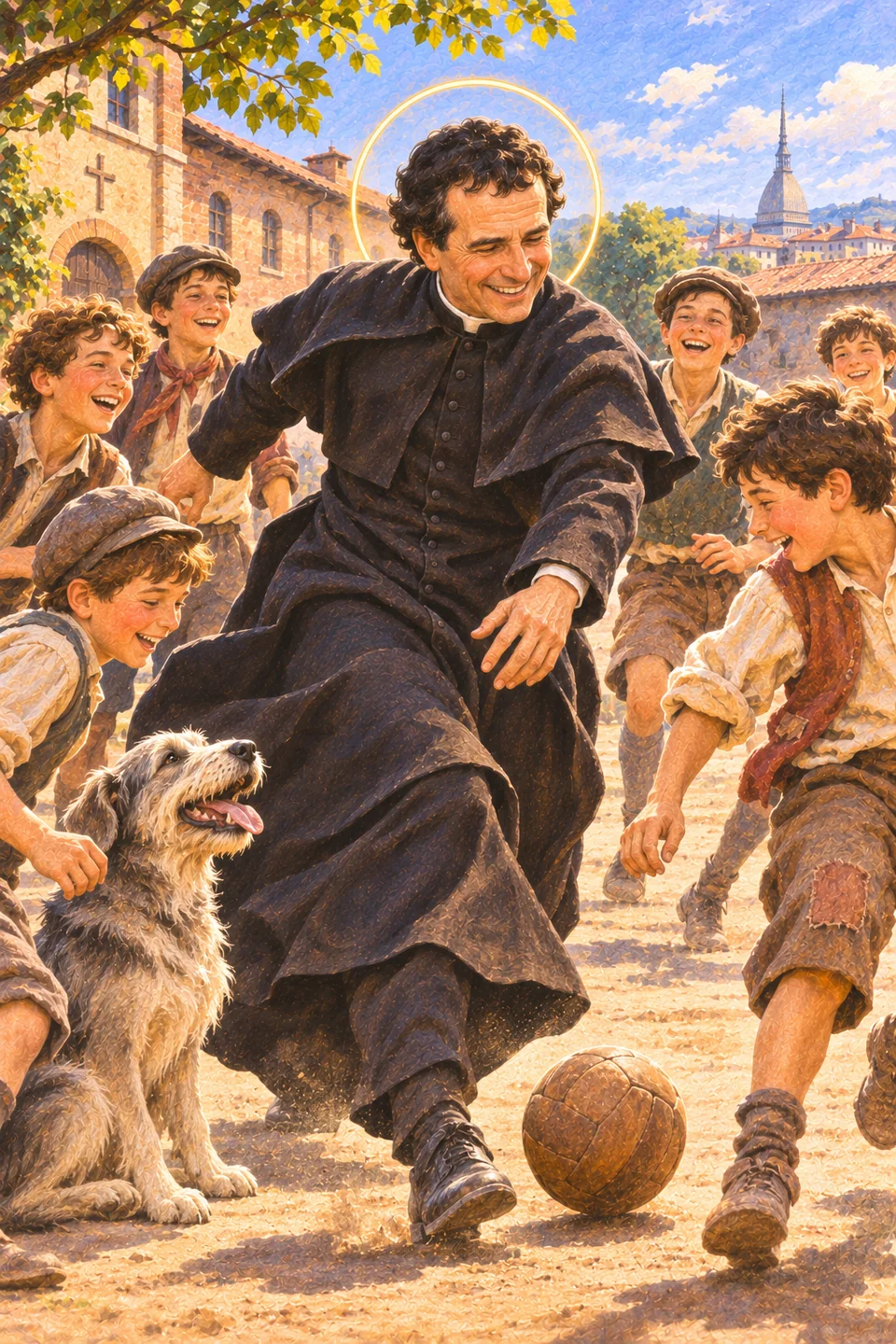
Turin’s streets could be dangerous at night, and some people wanted to stop John’s work. More than once, as he walked home alone in the dark, a huge grey dog appeared from nowhere, walked beside him and chased off men who attacked him.
John called the dog Grigio, which means “Grey”. He never found out who owned it, it refused food when he offered it, and he last saw it in 1866. John told the story himself.
Source: St John Bosco, Memoirs of the Oratory of St Francis de Sales, in Salesian Sources 1, Decade 3, chapter 24
Mamma Margaret
When John opened his home for boys in Turin, his mother Margaret, a farm widow nearly 60 years old, left her quiet village to help him. She cooked, washed and mended for dozens of boys, who called her Mamma Margaret.
She is on the way to being a saint herself: the Church calls her Venerable.
Source: St John Bosco, Memoirs of the Oratory of St Francis de Sales, in Salesian Sources 1, Decade 3, chapter 5; Catholic News Agency, “Mama Margarita, mother of John Bosco, declared Venerable” (2006)
When it was hard
John grew up poor, lost his father when he was tiny, and had to leave home because his older brother was against his studying.
In his famous dream, his first idea was to use his fists. John had to learn gentleness, and it took him a lifetime. Later, many people thought his work with rough street boys was crazy. He kept going, with a smile.
Source: St John Bosco, Memoirs of the Oratory of St Francis de Sales, in Salesian Sources 1, Decade 1, chapters 1 to 3
That the youngsters should not only be loved, but that they themselves should know that they are loved.
Try this
- Learn a simple trick (a coin trick, juggling two balls, a silly song) and use it to cheer someone up.
- Look out for someone at school or church who is on their own, and invite them to join in.
- Before his shows, John’s audience prayed the Rosary. Pray one decade of it together as a family, and if you like, learn its prayers in Latin.
A prayer
St John Bosco, you made friends with lonely, poor and difficult boys and showed them God’s love with joy. Help us to be friends like that. Pray for us.
For grown-ups: more about St John Bosco
Giovanni Bosco (1815 to 1888) was born at Becchi near Castelnuovo d’Asti in Piedmont and ordained in 1841. His Oratory, named after St Francis de Sales, settled at Valdocco in Turin in 1846. He founded the Salesians of Don Bosco in 1859 and, with St Mary Mazzarello, the Salesian Sisters in 1872.
His “preventive system” of education rests on reason, religion and loving-kindness. One of his pupils, Dominic Savio, who died at 14, is also a saint. Don Bosco was canonised by Pius XI on Easter Sunday 1934, and the Salesians now work with young people in well over 100 countries.